


Anti-Static Work Boots
Jiangxi Saizheng Shoes Co., Ltd. is an independent brand company specializing in the design, production, and marketing of safety shoes, work boots, rubber products, professional clothes, work clothes, and protection clothes. SaizProtex is our independent brand.
The company was established in 2014. It has been focusing on rubber sole safety shoes and occupying the rubber sole safety shoes market with excellent quality. The company strives for development based on credibility and survives based on quality. The company is located in the Longnan City National Industrial Park in Ganzhou, Jiangxi Province, a red Soviet area and the hometown of navel oranges in southern Ganxi.
Our Factory
Jiangxi Saizheng Shoes Co., Ltd. is an independent brand company specializing in the design, production, and marketing of safety shoes, work boots, rubber products, professional clothing, workwear, and protective clothing. SaizProtex is our proprietary brand.
Our Products
Our product range includes the production and sale of safety shoes for foot protection, anti-puncture safety shoes, anti-static safety shoes, electrically insulating safety shoes, as well as shoe materials, clothing, gloves, hardware, safety helmets, safety ropes, safety nets, and masks. We also offer fabrics, textiles, safety nets, sewing machine textiles, leather, mesh cloth, thread, ribbon fabric, hardware plastics, and cowhide.
Product Applications
Our products are used in various industries, including welding, petroleum, machinery manufacturing, petrochemicals, mining, agriculture and animal husbandry, glass processing, electric power, logistics, electronics, pharmaceuticals, and food.
Our Services
Warranty Service: We offer a warranty for our products, ensuring that customers have the right to repair or replace the product within the warranty period.
Technical Support: Our technical team provides support to help customers resolve technical issues during product use.
Customer Care: We regularly communicate with customers to understand their needs and feedback, offering personalized services and support.
-
![Black Anti-Static Work Boots]() Black Anti-Static Work BootsModel: RQ13 mid cutread more
Black Anti-Static Work BootsModel: RQ13 mid cutread more
Material: Two layer embossed cowhide
Sole: PU sole polyurethane sole
Technology: PU injection molding [optional cold stick] -
![Antistatic Work Boots]() Antistatic Work BootsModel: RQ14 middle cutread more
Antistatic Work BootsModel: RQ14 middle cutread more
Material: Two layer embossed cowhide
Sole: PU sole polyurethane sole
Technology: PU injection molding [optional cold stick] -
![Antistatic Work Shoes]() Antistatic Work ShoesModel: RQ15 mid cut + coverread more
Antistatic Work ShoesModel: RQ15 mid cut + coverread more
Material: Two layer emboweled cowhide
Sole: PU sole polyurethane sole
Technology: PU injection molding [optional cold stick] -
![Anti-Static Shoes]() Anti-Static ShoesModel: RQ16 middle cutread more
Anti-Static ShoesModel: RQ16 middle cutread more
Material: Two layer embossed cowhide
Sole: PU sole polyurethane sole
Technology: PU injection molding [optional cold stick] -
![Anti Static Work Safety Boots]() Anti Static Work Safety BootsModel: RQ17 middle cutread more
Anti Static Work Safety BootsModel: RQ17 middle cutread more
Material: First layer cowhide
Sole: PU sole polyurethane sole
Technology: PU injection molding [optional cold stick] -
![Anti Static Work Shoes]() Anti Static Work ShoesModel: RQ18 middle cutread more
Anti Static Work ShoesModel: RQ18 middle cutread more
Material: Suede cowhide
Sole: MD composite sole
Technology: Cold stick -
![Anti Static Boots]() Anti Static BootsModel:RQ19 middle cutread more
Anti Static BootsModel:RQ19 middle cutread more
Material: Velvet cowhide
Sole: PU sole polyurethane sole
Technology: PU injection molding [optional cold stick] -
![Anti Static Safety Boots]() Anti Static Safety BootsModel: RQ20 mid cutread more
Anti Static Safety BootsModel: RQ20 mid cutread more
Material: Two layer patterned cowhide
Sole: PU sole polyurethane sole
Technology: PU injection molding [optional cold stick] -
![Anti Static Safety Shoes]() Anti Static Safety ShoesModel:RQ21 mid cutread more
Anti Static Safety ShoesModel:RQ21 mid cutread more
Material: First layer leather
Sole: PU sole polyurethane sole
Technology: PU injection molding [optional cold stick] -
![Anti Static Safety Footwear]() Anti Static Safety FootwearModel: RQ22 low cutread more
Anti Static Safety FootwearModel: RQ22 low cutread more
Material: Suede cowhide Sole: PU sole polyurethane sole
Technology: PU injection molding [optional cold stick] -
![Best Anti Static Safety Shoes]() Best Anti Static Safety ShoesModel: RQ23 low cutread more
Best Anti Static Safety ShoesModel: RQ23 low cutread more
Material: Suede cowhide
Sole: PU sole polyurethane sole
Technology: PU injection molding [optional cold stick] -
![Anti Static Work Safety Shoes]() Anti Static Work Safety ShoesModel: RQ24 Mid-Cutread more
Anti Static Work Safety ShoesModel: RQ24 Mid-Cutread more
Upper: Top layer cowhide
Sole: PU Polyurethane Sole


What is Anti-Static Work Boots?
Boots classified as anti-static are made for workers who are in environments that must avoid static electricity. Such shoes are designed to dissipate the collection of static electricity from within the body while still providing some resistance to electrical hazards such as from live circuits. Typically, these kinds of boots might be classified with SD or ESD tags.
The significance of anti-static work boots becomes apparent when considering the potential risks in certain industries. Workers involved in airport refuelling, handling fine powders, or working with combustible materials are particularly vulnerable to static discharge accidents. A single spark can have catastrophic consequences.
Benefits of Anti-Static Work Boots
Non-Conductive Materials
Insulation shoes are made with materials that do not conduct electricity. They are typically constructed with rubber or other synthetic materials that have high resistivity to electrical current. This ensures that electric shocks are prevented from reaching the wearer’s feet, reducing the risk of injury.
Electrical Shock Resistance
One of the primary advantages of insulation shoes is their ability to withstand electrical shocks. The non-conductive materials used in their construction create a barrier between the wearer’s feet and the ground, preventing the flow of electric current. This feature is especially crucial for workers who deal with live electrical circuits or work in environments where electric shocks are a potential hazard.
Compliance With Safety Standards
Insulation shoes are designed to meet specific safety standards set by regulatory bodies. These standards ensure that the shoes provide adequate protection against electrical hazards. When selecting insulation shoes, it is important to check if they meet the relevant safety standards in your industry.
order to reduce or eliminate electrostatic hazards
Anti static Footwear is a working shoe that is worn in order to reduce or eliminate electrostatic hazards. Anti static shoes using the bulk of PU or PVC materials to make the soles, and the upper integrated on-line reinforcement molding, can effectively discharge static electricity, but also effectively suppress the workers in the dust-free room. The insulating shoe is a kind of safety shoe which uses the insulating material, its main function is separates the human body and the Earth this conductor.
Non conductive safety boots
The most commonly worn type of electrical hazard work boots are classified as non conductive. There is generally an EH (electrical hazard) rating listed, and the work boots are insulated to ground the electricity in case you come in contact with a live wire. These insulated work boots are generally worn when you are working on electrical equipment, and often include a protective steel or composite toe cap.
Conductive work boots
These specialty work boots are designed to keep your safe from electrical hazards in a very specific environment. It should be mentioned that these safety boots will not protect you from electrocution from live currents, only prevent your body from creating static electricity. These safety boots are generally worn by workers who are routinely around explosive chemicals and materials. The boots are designed to prevent you from transferring any static electricity to your surroundings that could potentially cause a spark, resulting in an explosion.
Electrical hazard shoes
Rated as EH, these shoes are generally insulated to help ground the worker from electricity in the event that he should step on electrical equipment or a live circuit. In addition to this, such boots may come with composite or steel toes in order to extend safety to the toes.
How Do the Anti Static Shoes Work?
Anti-static shoes are a special type of footwear which is mainly used to prevent the accumulation and release of static electricity, thus protecting the human body and the surrounding equipment. The principle of anti-static shoes involves several aspects, including material selection, electrical grounding and charge dispersion.
First of all, the material selection of anti-static shoes is crucial to their anti-static effect. Usually, anti-static shoes use special materials, such as conductive rubber or conductive plastic, to ensure the rapid dispersion and release of electric charge. These materials have good electrical conductivity and can quickly conduct the static charge to the ground or other conductive parts, preventing the buildup and accumulation of charge in the shoes.
Secondly, anti-static shoes need to be effectively electrically grounded with the ground or other electrical grounding facilities. Electrical grounding is the process of directing the charge to the ground or other grounding device, thus preventing charge accumulation and electrostatic discharge. Anti-static shoes are usually equipped with conductive soles and conductive laces, and these components can be connected to the ground or other grounding equipment to form a closed circuit that allows static charges to be effectively directed to the ground.
Anti-static shoes also reduce the buildup of static electricity by dispersing the charge. After wearing anti-static shoes, the conductive material on the sole is able to contact the ground or other conductive parts, forming a path for charge conduction. When the human body activities or friction with other objects, static charges will be generated, and these charged particles will be quickly dispersed to the ground or other conductive parts through the conductive material on the sole. In this way, the static charge will not accumulate inside the shoe, thus reducing the chance of static electricity generation.
The principle of anti-static shoes can be further explained as the rapid conduction and dispersion of electric charge. When static charges are generated by the human body or other objects, these charged particles are rapidly conducted to the ground or other conductive parts through the conductive parts of the anti-static shoes (e.g. soles and laces). During this process, the resistance between the static charge and the anti-static shoes is very low, so the charge can be quickly directed and dispersed, thus reducing the risk of static build-up and discharge.
Anti-Static Work Boots of Materials
Materials Used
The manufacturing journey begins with the careful selection of materials. ESD shoes are typically crafted using a combination of specialized conductive materials, including conductive rubber or polyurethane outsoles, and a blend of ESD-resistant materials for the upper portion.
Conductive Elements
The outsoles are infused with conductive elements, often carbon or metallic particles, to facilitate the efficient dissipation of static charges. This conductive property forms a crucial part of the overall ESD protection provided by the footwear.

Application of Anti-Static Work Boots
By preventing the accumulation of static electricity, anti-static shoes eliminate the risk of damaging electrical equipment and potential fire hazards. They ensure a safe working environment in industries where static control is critical.
Anti-static shoes are commonly used in industries such as electronics manufacturing, telecommunications, data centers, pharmaceuticals, and chemical manufacturing. These industries involve the handling of sensitive electronic components, where even the slightest electrostatic discharge can cause significant damage.
Insulation shoes are designed to provide protection against electrical hazards. These shoes feature non-conductive materials that help insulate the wearer from electric shocks. They are ideal for jobs that involve working with live electrical circuits, such as electricians, linemen, and power plant workers.
Insulation shoes are made from materials that do not conduct electricity. This prevents the flow of electrical current through the wearer’s body, effectively reducing the risk of electric shocks. Insulation shoes act as a barrier between the wearer and the ground, ensuring electrical safety in hazardous work environments.
Insulation shoes are commonly used in industries where workers are exposed to live electrical circuits or high-voltage equipment. These include electric utility companies, construction sites, power plants, and telecommunications infrastructure.
What We Should Know Before Using and Wearing the Anti-Static Shoes?
1) It eliminates the human body electrostatic active and can prevent the current electric shock protective shoes under 250V.
2) Mainly applicable to prevent the human body with static electricity and may cause combustion, explosion and other places where there is electrostatic hazard (such as petroleum, chemical, coal, printing, rubber, medical, purification, electronics and other industries work place)
3) Anti-static shoes generally should be resistance test once after wearing not more than 200 hours , if the resistance is not within the specified range(The resistor should be between 100K ohm to 100M ohms.), it can not be used as anti-static shoes.
4) When wearing the anti static or conductive shoes, you should not wear insulation wool thick socks and insulating insoles at the same time, and prohibited using as insulating shoes.
5) The use situation should be anti-static ground, and conductive shoes should be able to conduct the ground, to achieve a good anti static atomasphere.
6) Anti-static shoes should be used at the same time with anti-static clothing, pay attention to product cleaning, waterproof, moisture-proof.
How Should Anti-Static Shoes be Cleaned Correctly?
1. Before cleaning antistatic shoes, must choose clean room clean room, if in the ordinary environment cleaning, will adsorb dust in the air, and the more you wash the dirtier. Before cleaning, you should also check whether the shoes are broken or special stains, if the anti-static shoes are damaged, they should be repaired and cleaned.
2. Antistatic shoes can not be washed at high temperature or too low temperature, high and low temperature will destroy the fiber organization of antistatic shoes, so that the performance of antistatic shoes is reduced, the washing temperature of antistatic shoes is about 40 ℃ or so.
3. Anti-static shoes can not be soaked for a long time. In general, in order to scrub shoes clean, we will put them in the water to soak for a while, so that the stains can be removed more easily, but antistatic shoes can not, because antistatic shoes have leather and cloth surface, so there are different cleaning methods, leather shoes only need to be gently wiped with a soft cloth that is moist but not dripping water, until it is clean, and the cloth shoes need to be gently brushed with a soft bristle brush.
4, Anti-static shoes should not be brushed vigorously by hand, and the washing machine procedure should not be used, which will damage the conductive fibers inside the anti-static work shoes and affect the function of the work shoes.
5, Anti-static shoes should not be cleaned with acidic or alkaline chemical solvents, which will easily make anti-static shoes discolored or deformed, and should be cleaned with neutral detergent to ensure the performance of anti-static shoes.
Maintenance and Care Anti-Static Work Boots
Proper Care and Cleaning Procedures for Anti-Static Footwear
Regularly maintaining and cleaning anti-static shoes are essential for preserving their effectiveness and longevity. Follow manufacturer guidelines for cleaning and disinfecting the footwear, using appropriate cleaning agents and techniques to avoid damaging the anti-static properties.
Inspection Guidelines for Identifying Wear and Tear
Regular inspections of anti-static shoes are necessary to detect any signs of wear and tear that may compromise their safety and effectiveness. Check for cracks, tears, or excessive wear on the outsoles, upper materials, and stitching. Replace worn-out shoes promptly to ensure continued protection against static electricity hazards.
Storage Recommendations to Maintain Effectiveness
Proper storage of anti-static footwear is essential to preserve its effectiveness when not in use. Store shoes in a clean, dry environment away from direct sunlight, extreme temperatures, or harsh chemicals that could degrade the materials. Avoid stacking or crushing shoes, as this could damage their structural integrity and anti-static properties over time.
Jiangxi Saizheng Shoes Co., Ltd. is an independent brand company specializing in the design, production, and marketing of safety shoes, work boots, rubber products, professional clothes, work clothes, and protection clothes. SaizProtex is our independent brand.

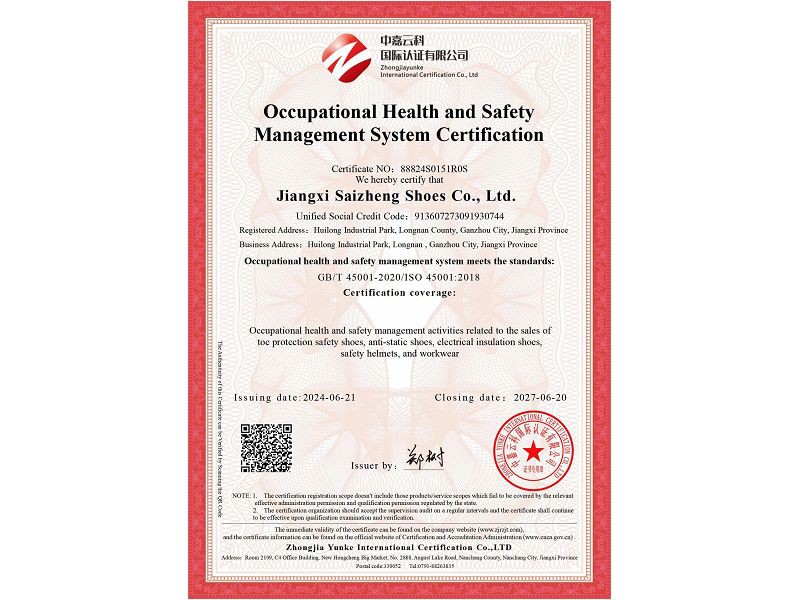
Our Certificate

FAQ
We're professional anti-static work boots manufacturers and suppliers in China, specialized in providing high quality products and service. We warmly welcome you to wholesale high-grade anti-static work boots made in China here from our factory.
esd occupational safety boots, best anti static safety shoes, antistatic work boots