


Work Boots
Jiangxi Saizheng Shoes Co., Ltd. is an independent brand company specializing in the design, production, and marketing of safety shoes, work boots, rubber products, professional clothes, work clothes, and protection clothes. SaizProtex is our independent brand.
The company was established in 2014. It has been focusing on rubber sole safety shoes and occupying the rubber sole safety shoes market with excellent quality. The company strives for development based on credibility and survives based on quality. The company is located in the Longnan City National Industrial Park in Ganzhou, Jiangxi Province, a red Soviet area and the hometown of navel oranges in southern Ganxi.
Our Factory
Jiangxi Saizheng Shoes is a modern self-owned factory integrating design and development, manufacturing, quality inspection and after-sales service. The factory is located in Gaomi, Shandong, with spacious, bright and well-planned standardized factory buildings and advanced and complete production equipment.
Our Products
Our product range includes the production and sale of safety shoes for foot protection, anti-puncture safety shoes, anti-static safety shoes, electrically insulating safety shoes, as well as shoe materials, clothing, gloves, hardware, safety helmets, safety ropes, safety nets, and masks. We also offer fabrics, textiles, safety nets, sewing machine textiles, leather, mesh cloth, thread, ribbon fabric, hardware plastics, and cowhide.
Product Applications
Our products are used in various industries, including welding, petroleum, machinery manufacturing, petrochemicals, mining, agriculture and animal husbandry, glass processing, electric power, logistics, electronics, pharmaceuticals, and food.
Our Services
Warranty Service: We offer a warranty for our products, ensuring that customers have the right to repair or replace the product within the warranty period.
Technical Support: Our technical team provides support to help customers resolve technical issues during product use.
Customer Care: We regularly communicate with customers to understand their needs and feedback, offering personalized services and support.
-
![Sports anti-smash safety shoes]() Sports anti-smash safety shoesModel: SZ6566 (breathable) Upper: imported first-layer suede leather + Oxford cloth Lining: high-density breathable mesh Steel toe cap: AN1 European standard Sole: polyurethane...read more
-
![Sports breathable safety shoes]() Sports breathable safety shoesModel: SZ6567 (breathable) Upper: imported first-layer suede + Oxford cloth Lining: high-density breathable mesh Steel toe cap: AN1 European standard Sole: polyurethane...read more
-
![Comfortable Puncture Resistant Boots]() Comfortable Puncture Resistant BootsModel:RQ10read more
Material: Suede cowhide
Sole: Rubber sole
Technology: Cold stick [optional PU injection molding] -
![Puncture Resistant Work Shoes]() Puncture Resistant Work ShoesModel:RQ08read more
Material: First layer leather
Sole: PU bottom polyurethane
Process: PU injection molding [optional cold stick] -
![Puncture Resistant Sole Work Boots]() Puncture Resistant Sole Work BootsModel: RQ06 Low Cutread more
Material: Two layer coated cowhide lightface leather
Sole: MD sole rubber sole
Technology: Cold stick [optional injection molding] -
![Man's Puncture Resistant Work Boots]() Man's Puncture Resistant Work BootsModel: RQ04 low cutread more
Material: two layer embossed cowhide
Sole: PU sole polyurethane sole
Technology: PU injection molding [optional cold stick] -
![Safety Shoes Anti-smash And Anti-puncture1]() Safety Shoes Anti-smash And Anti-puncture1Anti Shock Boots This type of labor protection shoe is designed to combine classic simplicity with durability and comfort. It has optional materials and is suitable for any environment. Model:...read more
-
![Men's anti-smash high top safety shoes]() Men's anti-smash high top safety shoesAnti Shock Boots This type of labor protection shoe is designed to combine classic simplicity with durability and comfort. It has optional materials and is suitable for any environment. ■Model:...read more
-
![Men's anti-smash safety shoes orange and black]()
-
![Men's anti-smash breathable safety shoes (perforated)]()
-
![Anti-stab plus velvet work shoes (high Top)]()
-
![Anti Smashing Safety Shoes]()


What is Work Boots?
We know that every job requires a certain type of shoe. But when it comes to manual labor, in many instances, it is mandatory to wear the kind of safety boots that can be adapted to any working environment. In these industries, injuries to feet are common. Workers' feet are exposed to hazards such as falling objects, bumps, grazes, punctures, sprains, falls, etc. As someone who is expected to carry out and monitor several operations, everyone's feet must be well protected.
Benefits of Work Boots
In factories, warehouses, storage facilities, and a host of other workplaces, steel-toe boots, and other safety footwear are crucial safeguards against the weight of falling objects that could land on your feet and cause serious foot injury.
The benefits of work boots extend beyond protecting your toe and the tops of your feet. Similarly found within the ASTM boot standards, they can also act as a necessary safeguard against puncture wounds that can injure the soles of your feet as well, thanks to a puncture-resistant plate between the insole and outsole.
In workplaces where cutting tools and machinery are used, the benefits of wearing safety toe boots or shoes include necessary protection against cutting.
Work boots aren’t just about protecting employees’ feet. One of the biggest benefits of wearing safety shoes is that they offer protection for the entire body by reducing the risk of slips, trips, and falls.
The best safety shoes offer treaded outsoles. Thanks to their extra grip, these outsoles provide traction that keeps employees upright on the job.
In certain workplaces, the benefits of wearing safety shoes, especially leather, include protection from burn injuries. Burn injuries can happen in any work environment. Still, employees may be at heightened risk if they work in laboratories and certain factories, plus a range of maintenance, janitorial, and junk removal services.
Type of Work Boots
Steel-toe boots
Steel-toe boots are designed to protect your feet from impact and compression hazards. They are essential for jobs where foot safety is a concern. In fact, some employers require this type of footwear as part of a uniform.
Composite-toe boots
Composite toe boots provide protection similar to steel toes but are made of non-metallic materials. They are lightweight and ideal for people who work with electrical components.

Waterproof boots
Waterproof work boots are designed to keep your feet dry in wet conditions. They often feature waterproof membranes or treatments on the leather.
A common preference among workers in many industries, waterproof boots may also be equipped with features associated with some of the other types of boots available.
Insulated boots
Insulated boots provide added warmth, making them ideal for those working in cold environments.
Material of Work Boots
Leather: There is no doubt that this is the most popular for workboots. It can offer a wealth of advantages, with one of the most significant being the fact that it is breathable, and hence, excellent when it comes to air circulation. It can also absorb moisture, and hence, preventing odour and the possible growth of bacteria. Leather is also durable, and more importantly, aesthetically-pleasing. Genuine leather, however, can be costly.
Nylon: If you are looking for safety boots that will be lightweight and breathable, those that are made from nylon can be a good choice. However, it is not as rigid as leather. More often than not, they come with mesh panels, which can encourage better airflow to keep your feet dry even after a full day at work.
Rubber: One of the most important characteristics of rubber boots is that they are water-resistant. More so, they can also resist abrasion, which makes it exceptional when it comes to durability. Nonetheless, one of the drawbacks of rubber is that it can be heavy and the fit cannot be customised, which might compensate your comfort.
What You Should Pay Attention to When Purchasing Safety Footwear
1. Safety
Whether you need composite toe construction boots for masonry or electrical-resistant work shoes for the power plant, every workplace has its own set of hazards.
Safety is a non-negotiable. It is the most critical aspect of a work boot. Therefore, choosing the right type can save you a toe, or even your life. No one knows tomorrow.
2. Support
Support in a work boot is determined by a variety of elements that come together to house your feet comfortably. When choosing a work boot consider the insole, midsole, shank, puncture plate, and outsole- they all contribute to offering you sturdy support.
3. Comfort, Fit, and Flexibility
If you spend 12 hours a day laboring away on your feet, you need without a doubt comfort work boots. Maximizing comfort will improve your job performance by uplifting your spirit and keeping your mind distraction-free.
Leather boots conform to your feet through repeated use, especially during the initial break-in process. To maximize the flexibility of your work boots you should consider regularly moisturizing them with a conditioner.
4. Insulation and Waterproofing
Walking around with waterlogged boots is no fun, and neither are frozen toes. That is the reason why weatherproofing your shoes provides you with comfort. Moisture is heaven at home for bacteria, and if you are always on your feet in wet shoes, it can be a severe threat. Thus having quality waterproof boots keeps you safe and warm.
5. Traction
Traction is an essential key to steadily standing on your feet. An excellent pair of work boots with a solid grip significantly does a better job than those that do not have any. Slipping, tripping, and falling pose a significant hazard and according to stats, a third of construction workers suffer injuries that result from them.
Hiking
Our work boots are designed to be worn straight out of the box with minimal discomfort. If you choose a pair of hiker style boots, like the popular Crosstrex, you can wear them on the job site, hiking through wet conditions, or out on a hunt. These boots are extremely versatile to help make your dollar go further.
Motorcycle riding
Since motorcycle boots and work boots share the same purpose – to protect your feet – they have a similar construction. Both are made of thick materials with heat-resistant soles with good thread. Don’t want to splurge on metal plated motorcycle boots? We don’t blame you; the classic look of American Heritage boots will work fine for us.


Snow
If you’re working in cold conditions, it’s likely that your work boots will be great for snow days. Look for work boots that are taller, have waterproof features, and have some level of insulation. That way whether you’re shoveling the driveway, trudging through the snow on a hunt, or working on a freezing job site, you’ll have solid protection from the outdoor elements.
Standing all day
A quality, properly fitted work boot is essential when you’re on your feet all day. Work boots can be good for long hours of standing and walking, or they can be terrible and cause sore feet and other issues. Choose a pair of boots that fit your feet, or size up and add a specialized insole. Some people opt for boots with a roomier toe box, like the Emperor series, to avoid cramped feet.
Hunting
A lot of the elements that work boots have are also practical for hunting boots. Waterproof features? Slip-resistant soles? Quality construction? There are even Wellington style work boots that you can slip on and off.
How Work Boots Are Made?
How the upper is made
Work boots companies will have their own ways of making each section of boots, but the processes will be very similar. Let’s start with the upper section of the boot, using the most common material.
In this case, the hide goes through a shaver, which evens it up before it’s waterproof and tanning. The tanning is usually done in a re-tanning drum using water and coloring products at 32-63°C.
How the outsole is made
Outsoles are made in different ways depending on what material is needed, and for whatever function.
The majority of work boots are made using various rubbers that are molded, where liquid rubber is poured into the mold at a high temperature and then cooled to set.
The mold often leaves an imprint of the company logo and other relevant information, such as the boot size and what country it was made in.
How they are attached to each other
Long gone are the days of nailing chunks of wood for heals onto the structure. Well for work boots anyway.
These days the outsoles are your Michelin or Goodyear tyres of the boot world. The tyres, sorry, rubber outsoles get vulcanized, which means welded to the main structure at approximately 165°. The edges of the soles are then sanded to remove residue of vulcanization.
Proper maintenance and care can extend the lifespan of your work boots, ensuring they remain effective and comfortable throughout their usage.
Cleaning
Wipe off dirt and debris regularly with a damp cloth to prevent buildup. For a comprehensive cleaning solution, check out Nicks Ultimate Boot Care Kit. It's equipped with everything you need to ensure your boots remain in pristine condition, no matter how often they need a touch-up.
Drying
Allow your boots to air dry naturally after use to prevent odors and mold growth.
Conditioning
Apply leather conditioner to keep the leather soft and prevent cracks.
Waterproofing
Reapply waterproofing products as needed to maintain water resistance.
Sole Inspection
Check the soles for wear and tear, and replace them if needed to maintain grip and safety.
Jiangxi Saizheng Shoes Co., Ltd. is an independent brand company specializing in the design, production, and marketing of safety shoes, work boots, rubber products, professional clothes, work clothes, and protection clothes. SaizProtex is our independent brand.

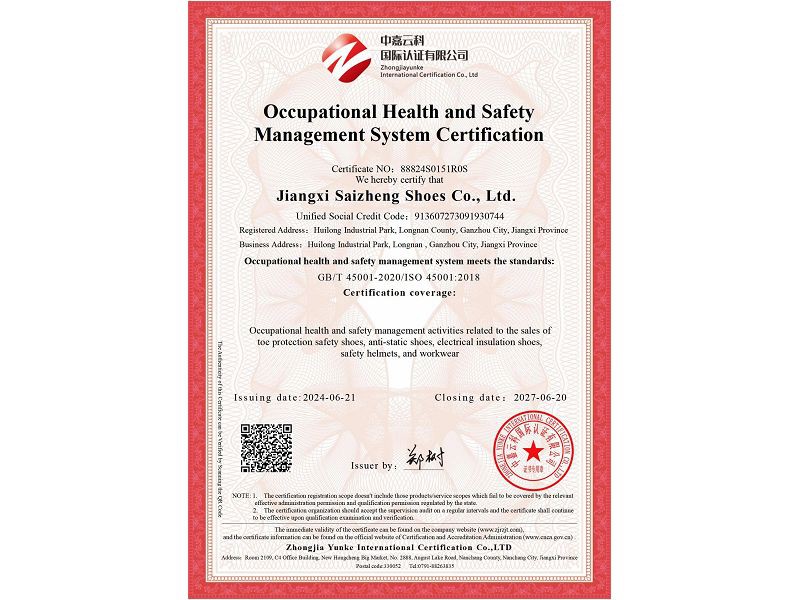
Our Certificate

FAQ
We're professional work boots manufacturers and suppliers in China, specialized in providing high quality products and service. We warmly welcome you to wholesale high-grade work boots made in China here from our factory.
waterproof work boots, work boot care, camouflage work boots